
Blog
Automated rebar tying: TyBot and the SkyMul start-up
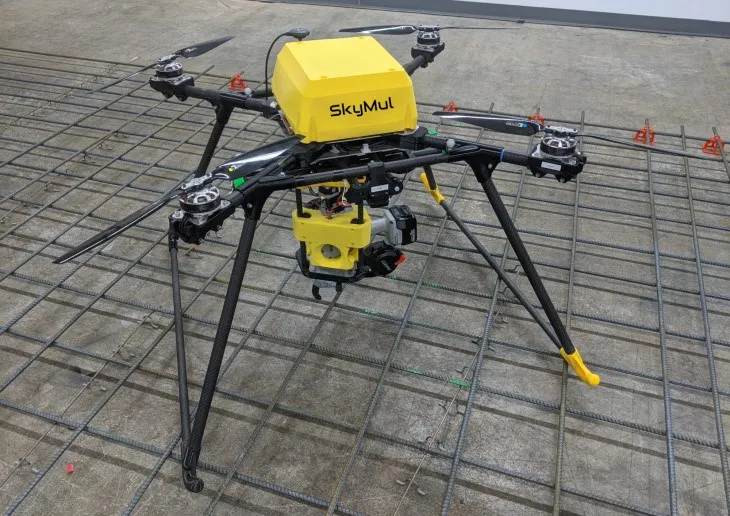
SkyMul drones tie rebar on the fly to speed up construction
The construction industry has many jobs that fall into the “dull, dirty and dangerous” category considered ripe for automation, but only a few of them can actually be done with today’s technology. One such job is the important and repetitive task of rebar tying, which the start-up SkyMul aims to automate fully with a fleet of drones.
If you have never worked with reinforced concrete, you may not know what rebar tying is. The steel reinforcing bars that give concrete floors, walls and other structures their strength are held in place during pouring by tying each bar to the others where they cross. A large building or bridge may require thousands of ties, and the work is usually done by hand.
Rodbusters (as rebar tiers are called, or so I am told) are masters of the art of wrapping a short length of plastic or wire around the crossing of two bars, then twisting and tying it tightly so that the bars are secured in several directions. It has to be done precisely and efficiently, and it is, but it is gruelling, repetitive work. While any professional should take pride in their work, I doubt anyone enjoys the chronic pain that comes from doing this task thousands of times an hour. As might be expected, rodbusters have high rates of injury and chronic conditions.
Automating rebar tying is difficult because it takes place in so many different situations. A known semi-robotic solution is TyBot, a kind of rail-mounted gantry suspended over the surface – but while this makes sense for bridges, it is a much less effective solution on the 20th floor of an office building.
SkyMul is a start-up still at a very early stage, but with an interesting proposition: rebar tying carried out by a whole fleet of drones. When you consider that tying does not require much force and that computer vision has become more than good enough to identify the points that need tying… it starts to seem obvious.
CEO and co-founder Eohan George said they evaluated a number of different robotic solutions, but drones were the only ones that made sense. Legged robots capable of picking their way across rebar are too expensive, while tracks and wheels are heavy enough to shift unsecured bars. The SkyTy system was developed following initial research at the Georgia Institute of Technology’s robotics lab.
Here is how it works. First, a mapping drone flies over the site to mark out the boundaries and then, in an automated flyover mode, builds a map of the rebar itself and of where the ties need to go. This map is then double-checked by a rodbuster technician acting as supervisor, which George said takes only about a minute per thousand square feet of rebar (though that quickly adds up).
The tying drones are then released, as many as are needed or wanted. Each one moves from point to point, hovering and descending until its tying tool (very similar to those used by workers tying by hand) reaches the crossing of the bars; the tie is wrapped and twisted, and the drone moves on to the next point. The batteries need changing every 25 minutes, which usually gives each drone time for 70–80 ties. At present each drone makes one tie every 20 seconds, which is in line with human workers, who can work faster but usually work at about the same speed or slower, according to figures cited by George.
It is hard to estimate the cost savings and the cost of running SkyTy, because labour costs vary greatly from one labour market to another. Typically, contractors at one level or another would lease and eventually own their own drones, although other models are also being explored.
The system also offers additional benefits, such as an accurate map of the rebar field created at the outset, which can be archived and used later for maintenance, quality control, comparison with drawings and other purposes. Once a contractor is satisfied that it is at least as good as the manual methods currently in use, it could save hours, turning a three-day job into a two-day one or otherwise simplifying logistics.
The company plans to offer SkyTy first for bridge construction, which is a simpler environment for drones than a multi-storey building. In the US alone, the rebar tying services market is worth around USD 30–40 million a year, providing an easier path to more complex deployments and expansion into most global markets.
